A Good Person

I have come to the conclusion that whether or not a person is a religious believer does not matter much. Far more important is that they be good human beings. The Dali Lama

Timothy James Hollis in What Really Matters by James Hollis:

Ethic

I have always believed in a strong work ethic
but the definition of which is widely different:
I didn’t do well in school;
I have gone job to job,
but what I worked on most,
the only thing I care about,
is being the best human being I can be.

This is in conflict with number crunchers,
those who still believe in a ladder to success.
I failed miserably in all those respects
and have a genuine friend from each of those experiences.

The definitions put forth in this culture, and many others,
work well for those like minded:
for those of us who are centered elsewhere,
it often ends poorly.

I know the routines very well and have performed,
but when I see an antlered buck on the side of the road
or a rock that sparks fascination,
or a grocer who is especially kind,
I feel alive.

Of course we need bridge builders and planners
and those with heart-mind of creating community,
and I think I am not an aberration
but a necessary part.

I do not advocate anyone follow my path:
there is a place, though,
for the mystical, the artists, poets and the like
to stop, for a second, the serious minded
and say, “look.”

Psychologist Abraham Maslow wrote that to save our world we must create the “good person.” He defined the good person as:

The self-evolving person,

The fully human person,

The self-actualizing person….

To become a good person is the work of a life time.

God and I

I had forsaken all priests. . . and those called the most experienced people; for I saw that there was none among them all that could speak to my condition. George Fox founder of The Religious Society of Friends

My  parents took my two older brothers and my younger sister to church and Sunday school every week. I went to summer church camp a couple of times and was confirmed.

I never really took to church.

Over several generations of my adult life, I tried church again, several times. I felt disappointed in my experiences and left.

Church, religion and religious leaders didn’t often “speak to my condition.”

In 1974 I spent a month in an alcohol treatment center. I’ve been chemical free for almost 41 years now. Treatment was a spiritual encounter—one of the most enlarging experiences of my life. I connected with fellow suffers and had a powerful experience of love and community. The Twelve Steps of AA discuss a higher power. I thought about my higher power. I realized that I prayed to the traditional God of my youth throughout my adult life–church or no church.

No one knows if God exists or if we have consciousness after death. Part of me believes in God. I continue to pray. But I have doubts. My relationship with God can be contentious at times as I struggle to understand how an all-powerful God can allow such evil and suffering in our world. Injustice and unfairness cause me to believe that God, if real, does not intervene in our lives so I don’t ask for things in my prayers. Instead I pray for strength, wisdom and courage. But on occasion the urge feels so strong that I ask for outcomes too.

Like George Fox, I don’t look to outside authorities for guidance. I follow no religion. I am my own learning laboratory. If God guides me, his direction and voice come from within me–from my deepest authenticity. But who can know for sure whose voice I hear?

I was born with consciousness. I can ponder my purpose in life, the values that I live my life by and I can imagine and create visions for my life. I can reflect on my experiences and learn and adapt from them. I strive to know and understand myself and to live true to my best self. I demonstrate my faith when I live my values and purpose even when times are uncertain and difficult. My belief in God is strongest when I am in nature and see her wonder and amazement.

I respect the beliefs and choices of people to take their own spiritual journeys and to express their beliefs in their own ways. I feel contempt for those who use religion to justify their evil deeds and stupid beliefs.

I can see, know and understand so little.

My spiritual journey continues.


Am I Doing the Right Thing?

The meaning of our life will be found precisely in our capacity to achieve as much of it as is possible beyond those bounds fear would set for us. James Hollis What Matters Most

In the summer of 2000, I decided to move to Ouray, Colorado: a little part of Western history nestled in the San Juan Mountains of southwest Colorado. I had visited Ouray many times over the previous decade and vowed to myself that if I ever had the chance, I would like to live there for a year just for the experience of the adventure.

My marriage had ended that spring and my mother had died about the same time. My best friend died shortly after. I worked for myself as a consultant. The time was right to take time to think, grieve, and reflect in the beauty of Ouray and the San Juan’s where I could sit in the warmth of the natural hot springs, drive the 4-wheel mountain roads and photograph the mountain beauty.

At first, I felt exhilarated by my decision. But then, as the first flush of excitement faded, the anxiety of uncertainty and the fear of the unknown crept into my soul. Negative possibilities filled my mind–all possible but improbable. For six months, I pondered many scenarios and contingency plans to gain a sense of control.

On December 26, 2000, I loaded my Jeep and a U-Haul trailer and headed west. I didn’t know anyone in Ouray. I had no clients anywhere near there. I had rented the second floor of a large A-frame home on the side of a mountain that looked over the Uncompahgre Valley between Ridgeway and Ouray, Colorado.

When I arrived, I exclaimed triumphantly, “I did it!” Then I thought fearfully, “What did I just do?”

“Did I do the right thing,” I asked myself.

I called Kenny Moore aka “Kenny the Monk.” Kenny wrote, The CEO and the Monk.

I asked, “Kenny, if I live on the mountain for the next 10 years and write, think and strive to become humble and wise and do some good deeds along the way and if I end up old, alone and broke, do you think a monastery somewhere would take a spiritual seeker in?” Oh, how I wanted certainty and security.

Kenny laughed, we had a long conversation and he sent me a prayer by Thomas Merton:

My Lord God, I have no idea where I am going. I do not see the road ahead of me. I cannot know for certain where it will end. Nor do I really know myself, and the fact that I think that I am following your will does not mean that I am actually doing so. But I believe that the desire to please you does in fact please you. And I hope I have that desire in all that I am doing. I hope that I will never do anything apart from that desire. And I know that if I do this you will lead me by the right road though I may know nothing about it. Therefore will I trust you always though I may seem to be lost and in the shadow of death. I will not fear, for you are ever with me, and you will never leave me to face my perils alone.

I struggle always to grow more comfortable with uncertainty and ambiguity.

I  walk into the mystery of life with all the integrity and authenticity I can muster. I leave security to take my uncomfortable soul’s journey.

I do my best to follow my purpose in life, live true to my values, and pursue my vision. I seek counsel from wise people. I reflect on the outcomes of my choices, and adapt as I go forward on my journey in life. I cannot know what lies ahead of me or how I will handle life’s challenges. Life remains unpredictable and beyond my control.

Faith is living my deepest authenticity despite fear (My late friend, Bob Terry believed authenticity was God). As afraid as I first felt on the mountainside, I didn’t deviate from my purpose or throw away my values. I continued to learn and adapt to life. I didn’t allow fear to stop me from this and many other leaps into the chaos and mysteries of life.

I’ve come to believe that there is not one right way to live. That would be mass conformity and such a human community would be unsustainable. I believe that the way to live is in a courageous and authentic way unique to each of us. Each soul authentically expressed has gifts to contribute to life. That diversity has the required variety to keep our human community vibrant and creative.

I Like Him Better the Older I Get

Allan Dale Heuerman (Scoop to all who knew him) died on this date 10 years ago. He was 90 years old.

I loved him then and find that I like, love and respect him even more the older I get. It’s amazing how much wiser he got the older I got.

I wrote shortly after his death:

It was Valentine’s Day—our deceased mother Harriet’s birthday. Dad had a chest cold and was congested. He went to bed and felt strange. He laid down and tried to call for help. He could not get up, and no one heard him. He laid alone for 8 hours until he was found in the morning. He had, months ago, told the staff not to check on him at night as they woke him up.

The dreaded call, anticipated for years, came at 7:00AM on February 15, 2005. A nurse from the Masonic Home was on the other end of the line. She said dad had suffered a stroke. Dad was conscious and coherent. His speech was garbled, and he had some paralysis on his right side. The ambulance was on the way.

Dad was alert and in high spirits at the hospital. He joked with the staff and bragged of his advanced age (he never imagined he would live so long) although his speech was slurred and not understandable most of the time. The early prognosis was good: he would make a full recovery and return to independent life. A day later everything changed.

Tests revealed that what he swallowed went into his lungs, not his stomach. He would require a feeding tube. Everyone said he was a good candidate for the procedure and might still make a full recovery. Then again he might not regain full use of his ability to swallow, and there could be other problems.

My dad was a proud, dignified, and independent man who still lived on his own. His mind was active and engaged and he wanted to die knowing who he was. He was mostly wheel-chair bound and his sight was slipping away. He had lived in a nursing home long enough to see what his future was. He had watched his wife fade away slowly as the medical profession tried to fix her for too long. He wanted to go out on top.

He listened to the doctor’s advice—pro and con–and said “No” to the feeding tube. He then changed the subject and talked of his great-grandchildren. He was ready to leave this world. We respected his decision and admired dad for his courage and deep sense of dignity.

Dad returned to the Masonic Home and was put on “comfort care.” Family came from near and far to be with him. His mind was sharp and he recognized family and friends although communications were difficult. A great-grandson visited. Dad reached out to him, pulled him close, wrestled his watch from his arm and slipped it on the boy’s wrist. The room wept.

I cried as I watched the Masonic Home resident’s pilgrimage to his room to say their final goodbyes. Their aged and broken bodies traveled by walker, scooter, and wheel chair. With full spirits they shared their stories of our father with his family. I could tell they were experienced with death. His dinner companion of three years told how he had to be interviewed to sit with dad. He said, “Your dad wanted a dinner companion who could carry on a conversation.”

Dad seemed to be in the place between this and the next life. He drifted in and out of each world. He felt no pain. He did not suffer. Once he looked upward and said, “Harriet, Harriet,” paused and said, “Open the door.”

My wife Melanie felt compelled to express her emotions. She said, “Scoop, I love Tom and will take good care of him for the rest of his life. He is a good man although from the stories I hear he was not always a good boy.” Dad managed to say clearly, “Good man, good boy.” His final approval of me will strengthen me always.

A son said a last goodbye. Dad spoke. His words were mostly incomprehensible but the word “son” was clear. Dad raised a fist and encouraged his oldest son to go forward.

I went to my father for my final private moments with him. I expressed my love and gratitude for him. I thanked him. I said he should not have any regrets. He had lived a good life with a powerful legacy. He had taught us well. His work was done. I loved him.

Finally the last son arrived from a world away. He went in and spoke to his dying father who responded to his presence. The goodbyes were done. Everyone had their own moments with dad and have their own personal stories and memories they will cherish. Everyone was ready.

My brother later recalled the end of the movie “Saving Private Ryan” when an aged Ryan visited the grave of the soldier played by Tom Hanks, who had saved Ryan. Ryan was an average man who worked, raised a family, and lived an everyday life. Ryan knelt at the grave and said to his wife: “Tell me I’m a good man. Tell me I’ve led a good life.” My dad lived a good life and was a good man. And we told him so.

Dad drifted off to a peaceful sleep never to awake again. My sister spent dads last night with him and comforted her peaceful father in her arms.

The next morning the hospice nurse said the time was near. Children and grandchildren gathered around dad who was at peace. We spoke to him, wept together, kissed and touched our beloved father and held his hands as he gasped twice and took his last breath.

And then he was gone. His was a good death.

We buried our father’s ashes with our mothers two days later. My dad loved sports, especially baseball as it was “a thinking man’s game.” At the end of the brief interment service, we put on baseball hats, passed out Cracker Jacks, and sang “Take Me Out to the Ballgame.” A family member reached over and dropped a baseball into the hole. Dad had hit a home run in the game of life. We dropped our roses into the hole with dad and went home with our memories and the exquisite pain and love of a powerful 11 days together.

Dad’s energy now flows free, his consciousness encompasses all, and he is connected to all of life. Our sorrow is joined by gratitude for our time together and pride in dad’s leadership.

I feel a deep alchemy taking place in my soul. I feel a churning of many strong emotions as I redefine myself without him here for the first time in my 59 years. My dad’s nobility inspires within me greater courage, greater passion, and deeper authenticity. This is the greatest of dad’s many gifts to me. I thank him for it. I wish it for everyone.

So long dad.

Trouble on Ruby Road

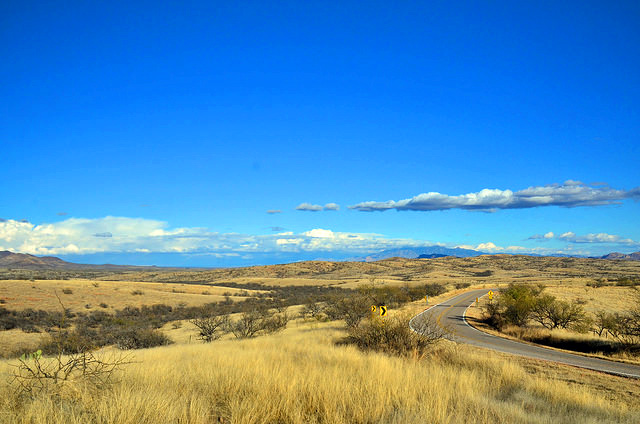
We hit the road early on a day-trip to Arivaca, Arizona. Sixty miles south of Tucson, Arivaca—a birding hotspot–is 11 miles from the International Border with Mexico and is home to 700 residents including artists and descendants of pioneer families.

Arivaca Road—a curvy two-lane road surrounded by stunning scenery–took us 23 miles from Amado, AZ to Arivaca:
15660861984_f6e3595618_z16097157419_5940d0d305_z16282452962_e6bf6db124_z

We made quick visits to the weekly Farmer’s Market and monthly swap meet and visited the Artists’ Co-op:

16475751555_435015134e_z15663419993_015ef6997d_z

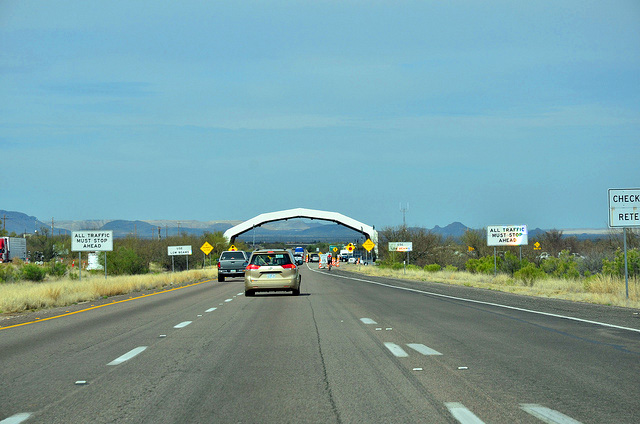
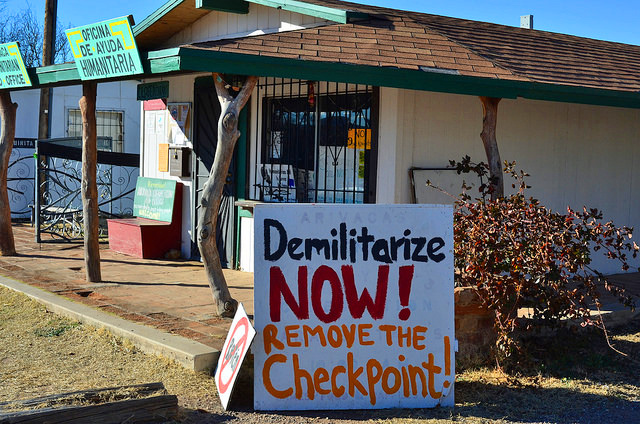
The Border Patrol checkpoints and heavy law-enforcement presence is not universally appreciated by the locals:

16346161648_4d159e2240_z16095755988_4c14a68cc6_z

Then it was off to a 1 ½ mile hike in the Arivaca Cienega:

16475720585_a0e9382145_z

Next on our list was a hike along Arivaca Creek and Mustang Trail to look for wildlife. On the way, Melanie spotted an antique store: a must stop. I told the owner about our hiking plans.

“Do you have a gun?” he said.

“No,” I replied.

“I wouldn’t hike there without a gun. Illegals use that trail.” (Later a friend familiar with the hikes said she had not heard of any issues on these trails with crossers.)

“What about Ruby Road,” I asked.

Ruby Road is a scenic unpaved mountain road that goes 34 miles from Arivaca to interstate 19 about nine miles north of Nogales, AZ.

“Turn around and go that way,” he said. “It will take you about an hour.”

Off we went.

I spent 2001 living on the side of a mountain near Ouray, Colorado. I drove the 4-wheel roads into the mountains throughout the 14 months that I lived there. I loved the exploration, the challenges, and the photo opportunities. I was excited to take the drive. Melanie not so much: she reclined her seat so she wouldn’t have to look over the edges of the road.

The road was rough with water pooled in the low spots. I drove about 10-15 miles/hour.

Six miles down the road, we stopped and looked at Arivaca Lake:

15853125034_938e1efc5b_z15853137274_635506d019_z

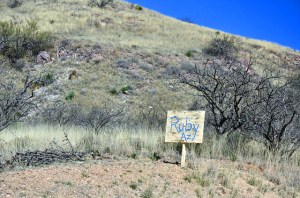
Further down the road was the ghost town of Ruby:
16475643175_e00d87f7a9_z

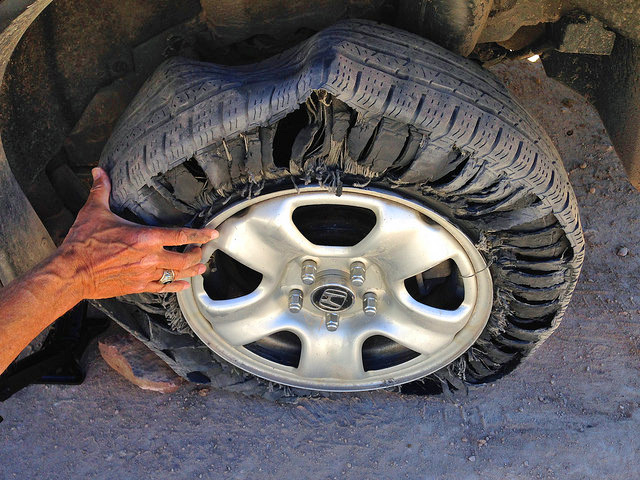
The road was rocky. I began to wonder if we had a flat tire. Our SUV rode okay but sometimes it sounded funny. I didn’t say anything. I didn’t want to have a flat tire. Melanie later told me the same thing. She said, “I didn’t say anything because it might make it real.” Our responses were good examples of denial in action.

The hour drive was now over three hours.

I looked into the rear-view mirror. A border patrol truck was behind us. I pulled over so he could pass me. He stopped and said, “You have a flat tire. Good luck.” And off he went.

I found a mostly flat place to stop. Out came the spare tire. At first I couldn’t get the lug nuts to move. I put the wrench on one and jumped on it with 200 pounds.

The lug-nut turned and I did the same on the rest.

I got down to take the tire off. It wouldn’t move. I tried over and over and it would not move. Images of being stranded for hours and paying hundreds of dollars to get the SUV loaded on a flat-bed truck flashed through my mind.

Melanie was not happy. She feared smugglers and driving off a cliff; I feared her.

15856541553_3c98cd19b2_z

A truck drove by. I chased it down the road and hollered, “Can you tell us where we are?” I knew where we were but didn’t know the roads to be able to describe where we were if we had to call for help.
The man and woman stopped and got out and we studied the map. He tried to get the tire off the wheel—it didn’t budge.
Just then another border patrol agent stopped. He tried—no luck. Then another agent came from the opposite direction. He tried—the wheel was stubborn.

I got a cell-phone signal. I called AAA. One of the agents took the phone and told the customer service person our coordinates.

The man who had stopped said, “I wish I had a hammer with me. I could hit the wheel and maybe loosen the tire.”

The second agent to arrive said, “I have a hunk of wood in the truck.”

He got under our car and whacked the tire with the heavy piece of wood. It moved!

We asked the Border Patrol agents for their names so we could write a letter to their bosses praising them. They declined. I shook hands with the man who had the “whack it” idea and hugged his wife goodbye.

Five minutes later, we were on our way down the final hills to interstate 19 and the drive back to our winter home. We called AAA—who had been great–and cancelled the service call.

It was late and the two tire stores we called were going to be closed soon. We decided to park the car until Monday and then go to buy a new tire.

On Sunday night, I noticed the other back tire was flat.

We called AAA the first thing on Monday morning. They came and inflated the tire. We hurried to a tire place before the tire went flat and purchased two new tires.

I should have known better. The first two 4-wheel-drive trips I took in 2001 resulted in flat tires. One at 12,000 feet and the other at about 10,000 feet in a driving rain. I quickly replaced all the tires.

I had forgotten the lesson I learned in the San Juan Mountains: don’t drive unpaved  roads that are not maintained with standard tires.

Big thanks to the Border Patrol agents, AAA, and the couple who stopped to help.