Ideals Require Courage

It’s really a wonder that I haven’t dropped all my ideals, because they seem so absurd and impossible to carry out. Yet I keep them because in spite of everything I still believe that people are really good at heart. Anne Frank

Republican presidential candidates should heed Anne Frank.

The terrorist attacks in Paris triggered a reality show that featured Republican presidential candidates in the midst of a group panic attack.

“This is a clash of civilizations,” incorrectly asserted the too-slick Rubio.

“Only let Christians in,” bawled the passive Bush and scary Cruz.

“Close America’s door to orphaned toddlers from Syria,” roared the bully Christie.

“Close the Mosques,” bellowed the hollow-man Trump who thinks requiring Muslims to wear an identification card is a good idea.

Giving neurosurgeons a bad name, Ben Carson compared Muslims to “mad dogs.”

“No refugees can come to our states,” proclaimed unlawful and “the sky is falling” Republican governors (and one democrat). They whined in mass when President Obama called them “un-American.”

And President Obama’s opinion: “The enemy of America is not our many Muslim friends…our enemy is a radical network of terrorists and every government that supports them.”

I’m with the president.

For those of us fearful of a terrorist from Syria coming into the United States as a refugee, I quote from the Economist:

“Refugees apply for resettlement at American embassies or through the United Nations. If they pass that first hurdle, they are screened by outposts of the Department of State all over the world. They undergo investigations of their biography and identity; FBI biometric checks of their fingerprints and photographs; in-person interviews by Department of Homeland Security officers; medical screenings as well as investigations by the National Counter-terrorism Centre and by American and International intelligence agencies. The process may take as long as three years, sometimes longer. No other person entering America is subjected to such a level of scrutiny.”

I don’t like demagogues for leaders or politicians who fear-monger and demonize others to justify going against our values. Heed Voltaire’s observation: “those who can make you believe absurdities can make you commit atrocities.”

I don’t like leaders who try to make political points by refusing the helpless and powerless—most of them women and children.

I like my president and congressional leaders to be calm, deliberate, and thoughtful. I also like my leaders to be courageous, compassionate and clear thinking. Leaders stay true to long-held American values in the toughest of times and this is not one of America’s toughest times. Real leaders protect the powerless and helpless and women and children.

The attacks in Paris gave us a window into ourselves and those who aspire to lead America into the future.

Do we want a president with an apocalyptic world view who loses his nerve in a crisis and shoots before he aims? Do we want to lose our humanity?

Republican presidential candidates failed the real-time test of presidential leadership: Their eagerness to run from American values to get votes disqualifies them as serious presidential candidates.

Terrorist attacks scare us. That’s understandable. But let’s not get hysterical and let fear bring out the worst in us and allow the terrorists to win. We defeat the terrorists with courage and adherence to America’s history and core values. What will be become of us as a nation if at the first moment of fear we throw out our values and fall-apart?

A friend wrote: “If we set policy based in fear we fail. If we set policy based on our values, we redeem ourselves. Nothing less than our identity as a nation is a stake.”

P.S.
“The vote by the House of Representatives effectively to slam the door on Syrian refugees was the crassest kind of political grandstanding, scapegoating some of the world’s most vulnerable people to score political points.” Nicholas Kristof, NY Times, Nov. 22, 2015

Are We Good Enough for the Times?

When I hear folks say that, well, maybe we should just admit the Christians but not the Muslims; when I hear political leaders suggesting that there would be a religious test for which a person who’s fleeing from a war-torn country is admitted, when some of those folks themselves come from families who benefitted from protection when they were fleeing political persecution—that’s shameful. That’s not American. That’s not who we are. We don’t have religious tests to our compassion. —President Obama: http://go.wh.gov/Qr48Yt

Republican leaders do nothing to stop deranged young men from buying automatic weapons to use to commit mass murders in our schools, churches and movie theaters. To do something would require them to have the courage to risk their political jobs and stand up to the NRA and do what is right.

But they have no difficulty refusing sanctuary in America to helpless and powerless refugees—mostly women and children. Even to refuse under 5-year-old children to enter America (Chris Christie). Or to discriminate against them based on their religion (Jeb Bush, Ted Cruz) or threaten to close their Mosques (Donald Trump) in the country of religious freedom. Instead they hysterically try to seize the political moment to manipulate the fears of ignorant Americans and benefit politically from the suffering of victims of terrorists. They think themselves so tough. I think of them as men of weak character.

Political posturing on the despair of the powerless is particularly despicable.

Where are their ideals of courage and compassion and a commitment to clear thinking?

Republican presidential candidates have failed the test to be commander-in-chief.

Too many of us in all walks of life have lost a commitment to important American ideals in our effort to win the next election, gain the new promotion and have a life of personal comfort.

Our ideals guide us all the time, especially when the times are difficult. The behaviors our ideals require separate us from those who hate us. If out of fear and ignorance we abandon our values in tough times, what distinguishes us from those who want to destroy us?

Scott Peck, MD wrote that stress is the test of our goodness. Watch our presidential candidates, discern their motives and see which ones show the maturity, character and clear thinking needed to be president in the times in which we live. And which ones stay true to America’s core values of courage and compassion even when afraid.

Hopefully the panic and madness will pass soon.

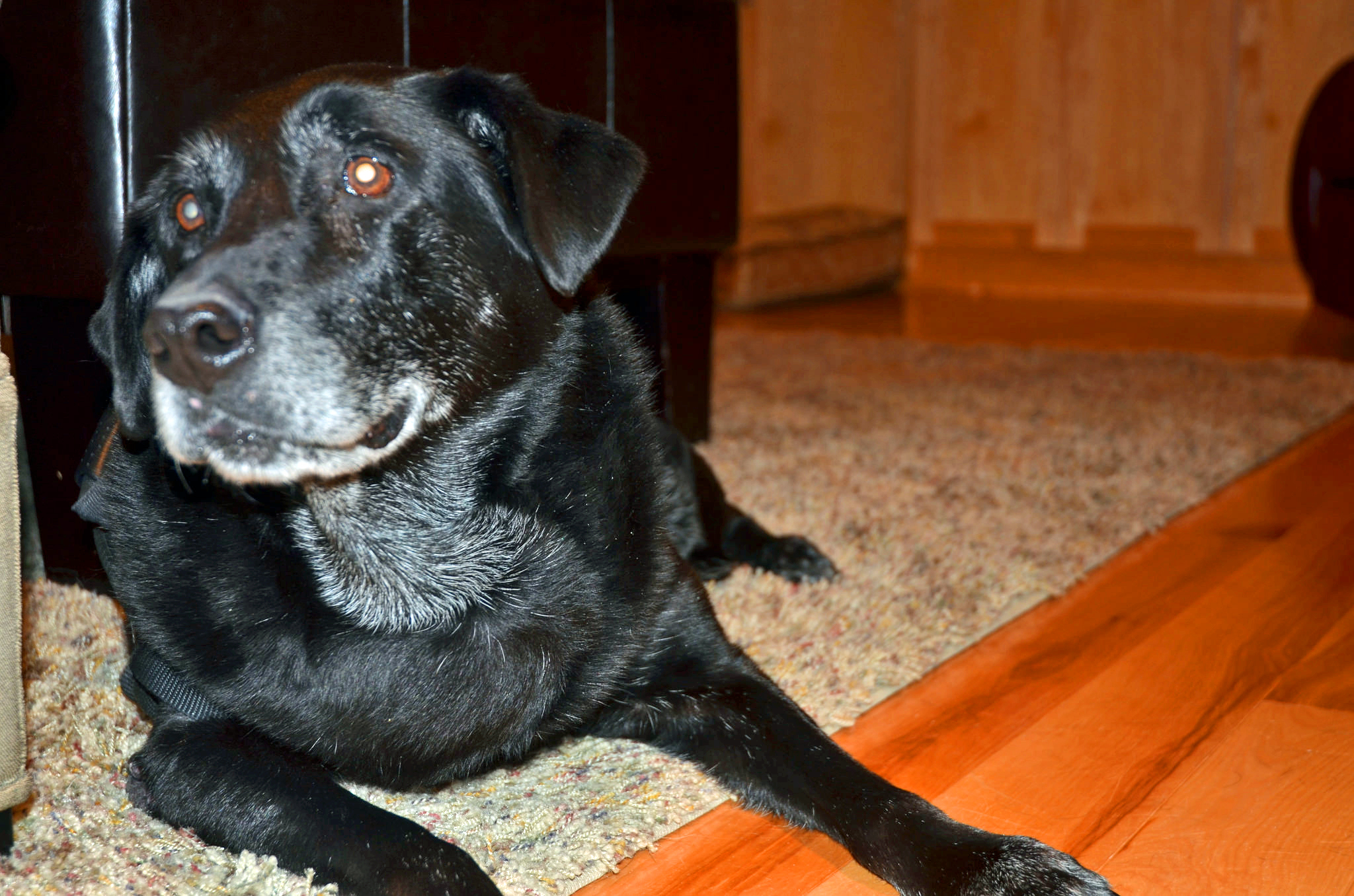
Maddy

Madison was a great dog. Dr. Ken

We said goodbye to our beloved Maddy recently.

Maddy was Melanie’s dog before we married 13 years ago. I wasn’t particularly drawn to black labs. But I worked from home and spent much time with Maddy and Casey, our American Eskimo.

We walked five miles almost every day. Maddy loved to walk and run away if she could. We thought we had lost her a few times but after an hour or so she would come home with a big smile on her face.

We went to the lake in the summer. She loved to swim. We threw things for her to fetch and she would swim all day long if she could.

10682043854_d80c66bc99_o

Maddy was a lover. She connected with everyone she could get close to. She liked to burrow her head into and through you and would be so excited that it was hard to pet her. She never gave or received enough affection.

I came to love Maddy.

10681962975_57e7f09a9a_o

The years flew by. She was now more than 14 years old and had issues the last two years. Her back legs were bad and our walks went from five miles a day to a long block on a good day. It was painful to watch her lie down: so stiff and slow. It had to hurt, but she never showed it. Dr. Ken said, “She is a tough dog.”

Stiff and sore or not, she never hesitated to get up when Melanie or I were in the kitchen where she might get some food. She ate anything fit for human consumption and much that wasn’t.

The time came when she was unable to control her bowel movements. We coped with it for 18 months and frequent messes were hard on us. We tried to figure out her digestive system so we could predict when it was time to get outside but we never could. She became more and more unpredictable. It hurt us to restrict her to the mudroom near the end of her life. She didn’t like it.

Casey has lived with Maddy all of his 11 years. He began to show symptoms of anxiety. He didn’t seem to like it that Maddy had to be in the mudroom. When Casey ate, Maddy would stand behind the gate and stare at him. Casey began to move his kibble, one piece at a time, to a place out of Maddy’s sight, eat it and go back for more. He snuggled closer to Melanie and me and aggressively scratched the floors and rugs.

We hoped and prayed Maddy would pass in her sleep.

Finally we went to Dr. Ken. He told us it was time for us to act on Maddy’s behalf.

We took 11 days to try to prepare ourselves and to say goodbye. The kids spent time with Maddy. They took wonderful photos. Maddy loved their visits.

We cried—some openly, others privately.

22560309620_feb9afee92_k

The dreaded day came. We filled up with guilt and sorrow. Maddy got extra food and treats.

She was thrilled to go for a ride.

We arrived at the animal hospital and Melanie walked Maddy outside and let her smell the piles of leaves—always a big attraction. We went to an examination room. We gave her lots of dog biscuits while we waited for the doctor.

Maddy was happy to see Dr. Ken. He administered a sedative. Maddy never seemed to feel shots and she showed no sign that she felt the injection. She laid down as the drug took effect. Dr. Ken picked her up and put her on the examination table. When we were ready, he administered the shot. Maddy did not react.

And then she was gone.

We stayed with Maddy for a time and cried over her.

I hope this great dog knew how much we loved her.

Enemies or the Opposition?

You have enemies? Good. That means you’ve stood up for something, sometime in your life.
Winston Churchill

Hillary Clinton jokingly referred to Republicans as enemies while Joe Biden said Republicans were not enemies but the opposition in Congress.

I believe that the leading Republican presidential candidates, who appeal to America’s darkest fears, would lead the nation into accelerated decline and would revive the vilest aspects of America’s history and shadow side. And indifferent Democrats may let that happen.

Author and psychologist Rollo May defined a pseudoinnocent as a naive person who has blinders on and who does not see real dangers. Pseudoinnocents cling to childhood assumptions about the nature of the world. They do not want to acknowledge power or aggression much less use their innate power and aggression. How many indifferent Americans are pseudoinnocent and cannot see the dangers that threaten their way of life or the life they aspire to?

Author of The Denial of Death, cultural anthropologist Ernest Becker wrote: “If everyone lives the same lies about the same things, there is no one to call them liars. They establish their own sanity and call themselves normal.” I often think of Fox News, conservative talk radio and the extremists of the Republican Party when I read this quote.

The most extreme of the Republicans live in their own illusionary and shadow-filled Plato’s Cave and convince themselves of the normality of their regressive visions and black/white and either/or world. The cave-dwellers collude together to fleece the naive people who follow them. And many pseudoinnocent Republican voters seem happy to get hustled over and over again by the same false promises.

Many pseudoinnocent Democrats believe if they could get those who yearn for a return to the past to understand their vision for the future, those people would change. This was, I believe, a problem of President Obama’s: He didn’t seem to understand how serious and base his enemies in Congress and in the Republican Party were. I don’t mean people who disagreed with him on philosophy or policy. I mean those who wanted to harm him personally. He lacked the ruthless streak a leader needs to deal with those who hated him and wanted to destroy his presidency.

Early in Obama’s presidency, I wrote to Chief of Staff Rahm Emanuel: “What are you people doing? You make nice with people who want to kill you!” How did that approach work out for America with immigration, climate change and income inequality and so many other issues?

Republican and Democratic voters need to awaken and see reality as it is. Villains and injustice exist. They do not respond to argument and common sense; they respond only to power. We live surrounded by them in, perhaps, more insidious ways than ever before. Naïve and indifferent people, who make up a significant percentage of the adult population in America, allow the scoundrels to have their way.

We need to make wise moral judgments. It is wrong and irresponsible not to. We need to judge our politicians and hold them accountable with our votes.

Serious about her enemies or not, Hillary Clinton has battled the dark side of the Republican Party for decades with strength and resolve. She has gained wisdom and insight.

Americans need a battle-scarred warrior to lead them in today’s dark world.

Who’s the Enemy?

Deeply anxious and afraid Republican primary voters express their deep outrage with their political leaders: maybe hatred best describes their generalized feelings towards the “establishment.”

They wrongly seek leaders who will take them back to a black and white world—to quote NY Times Columnist Thomas Friedman, “To the certainties and prosperity of the Cold War or post-Cold War eras—by sacking the traditional elites who got us here and by building walls against change…” (NY Times October 21, 2015).

Rigid black and white world views shatter in times of chaos and uncertainty. Stressed people and groups tend to regress in their maturity and goodness—see the Benghazi Committee. Fear and anxiety will do that. The inflexible want “parents” to take care of them, heroes to rescue them from dangers real and imagined and magicians to do the impossible. Judgement suffers and the either/or folks fall prey to false prophets: those who prey on their hopes and fears to advance themselves. Why do they listen over and over again to those who lie and use them?

The angrier they get the more demanding and inflexible they become. Poor leadership is not divorced from themselves: Republican extremists co-created the state of the Republican Party. Their leaders reflect them: the people who put the leaders in place (see the Freedom Caucus in the House of Representatives).

How do the majority of us who are not today’s Republican extremists avoid falling victim to regression?

Robert Greenleaf, author of Servant Leadership wrote:

Who is the enemy? Who holds back faster movement to a better world? Who is responsible for the mediocre performance of so many of our institutions?” It’s not the evil, stupid, ignorant, or apathetic people. If the world is transformed there will still be evil, stupid, ignorant, and apathetic people. The enemy is indifference.

The Republican extremists are not indifferent. Fear driven and victims of a mechanistic world view, they are just wrong about so many things.

We cannot go back to an earlier time: life is complex, changes always and moves steadily into an unknown potential-filled future. Resistance to the need for change only causes more fear, pain and danger for all. We avoid regression when we step boldly into our unknown futures and adapt as we go.

Democrats are angry too: enraged with Republicans. Their anger should be redirected to getting people who support their causes out to vote.

Will the election of 2016 move America to a positive future? A renewed future for America and her citizens depends on the poor, the young, students, immigrants, minorities and the middle class: on those who want to heal our planet, educate our citizens, reform immigration, have a robust middle class, and evolve human rights for all people.

The tired migrants, the cynical students, the disillusioned minorities, the anxious middle-class and the desperate must awaken and vote for the future they want for themselves. So simple—go vote for your self-interest.

God will not save us. False prophets will fail to be great, heroic leaders cannot endure, parents cannot take care of us and the tricks of the magicians are illusions. We are responsible.

This is not a time for indifference.

Reflections at 70

I’ll be 70 years old soon. It feels like a big deal: scary as the awareness of time passing pushes into consciousness. I’m no longer in the second half of life: I’m in the last 20% of my life. My brother’s death this past summer—quick and unexpected–made the uncertainty of life palpable. For a while now I’ve reflected on my life from the edge of old age.

I’ve had successes and disappointments and many peak experiences. I’ve sought to live creatively and to feel alive. I’ve pondered my values and purpose in life often and have mostly lived true to them. When forced to choose, I’ve taken values and quality experiences over money. I’ve learned how to renew myself and my life intentionally. My biggest work success was leading organizational transformation and experiencing a grand awakening of my own.

Marrying Melanie was the best decision of my life. We live in sync with one another and I learn so much from her. We support one anther’s journey in life and sacrifice for each other. We learned long ago that love is a verb and we are active in our love for one another. I’ve had a few true friends and understand that family extends beyond blood.

My darkest time was a fall into the abyss of alcoholism as a young man—a place of despair where alcohol took my soul. My greatest personal triumph is my continued sobriety (managing a chronic illness) that now exceeds 41 years (knock on wood). I would say I am resilient, always move toward greater growth and learned long ago to stand alone when my values conflict with the crowd, which they did often in the corporate environment. I can also be cranky, impatient, obsessive and spend too much time fretting about stuff.

The older I get and the more I learn, the more I realize how little I know and how insignificant I and we are in the vast cosmos. I don’t know if God is real or if there is consciousness after death. I may find out when death arrives for me. The best preparation for whatever lies beyond death is to live a life of passion and creativity.

Sorrow accompanies me and grows as I age. Endings and losses increase. Tears come quicker. I’ve kept the awareness of death close since my 40’s. The consciousness of my mortality has helped me cut through the superfluous when I make difficult decisions. The awareness of death makes life more passionate. Now, as time grows shorter, my desire to experience life and feel the love that surrounds me grow even more intense.

Thinking about the past is often a bummer. Thinking about the distant future has diminished value. I find it best to live in the here and now (hard to do) and find the most meaning I can each day. More and more the natural world is my source of peace.

I feel grateful for being alive and for living in a nation where I am free to engage with my destiny.

The reflections will shift my inner landscape a bit but won’t change much externally. I am healthy and fit. I plan to live in the future as I’ve lived in the past. As my brother did, I will leap into the future and live fully. As my father did, I hope I will then die a noble and courageous death.

These are my intentions.

Pope Francis on Migration

I am not a Catholic; I am not a church-goer. I have doubts about the existence of God and of consciousness after death. Yet I felt a powerful call to pay attention to Pope Francis when he visited America. The origin of this summons was my deep and urgent hope for a global leader to rise from the chaos and darkness of global turmoil, violence, regression and destruction—a visionary and value-driven leader of moral courage who can ascend above the numbing and destruction of the human spirit (evil) so common in today’s world and lead a conscious evolution of the human condition in a direction of greater wisdom and maturity.

I paid rapt attention to the Pope’s visit. Several things touched me. One of them:

The Pope said to Congress:

On this continent too, thousands of persons are led to travel north in search of a better life for themselves and for their loved ones, in search of greater opportunities. Is this not what we want for our own children? We must not be taken aback by their numbers, but rather view them as persons, seeing their faces and listening to their stories, trying to respond as best we can to their situation. To respond in a way which is always humane, just and fraternal. We need to avoid a common temptation nowadays: to discard whatever proves troublesome. Let us remember the Golden Rule: “Do unto others as you would have them do unto you” (Mt 7:12).

Jewish theologian Martin Buber wrote of I-It and I-Thou relationships. I-It relationships relate to an entity as an object, whose only value is extrinsic. In an I-It relationship we value a creation only insofar as it serves our purposes. This is the relationship we have towards objects, and, sadly, too often, towards other people. Thinking of people as objects makes it easier for us to demonize and discard them.

The I-Thou relationship is the relationship we should always have with other people. This is a relationship of respect in which the person has intrinsic value, value in and of himself or herself, regardless of whether that person can produce any external value for us. In an I-Thou relationship we see another person as a soul that seeks expression, just as we ourselves do. We understand that what we do to others we do to ourselves. We treat others as we want to be treated. The I-Thou relationship demonstrates dignity and responsibility.

Melanie and I spent last winter in the Sonoran Desert not far from the border with Mexico. My observations prompted me to read to learn more about the crossers–the people the Pope talked about–to better experience them as fellow human beings. In search of a better life, they are often demonized, marginalized and victimized. People on both sides of the border often treat them as objects and abandon them to die anonymous and lonely deaths cared about by no one.

But for the randomness of biology, we too might be one of these forgotten people.

No one has the right to harm the spirit of another.